You can rank number one on Google and still lose the featured snippet to a page sitting in position four. That probably sounds backwards, but it happens every day. Featured snippets do not go to the page that ranks highest. They go to the page that answers the question most clearly, in the format Google wants to display.
That distinction matters a lot in 2026. Google's search experience is increasingly dominated by answer boxes, AI Overviews, and structured content summaries. If your content is not formatted to feed those systems, you are leaving organic visibility on the table regardless of how strong your traditional SEO is.
This guide will walk you through how featured snippets actually work, why some pages consistently win them while others miss out, and what practical steps you can take to change that for your own content.
What Are Featured Snippets?
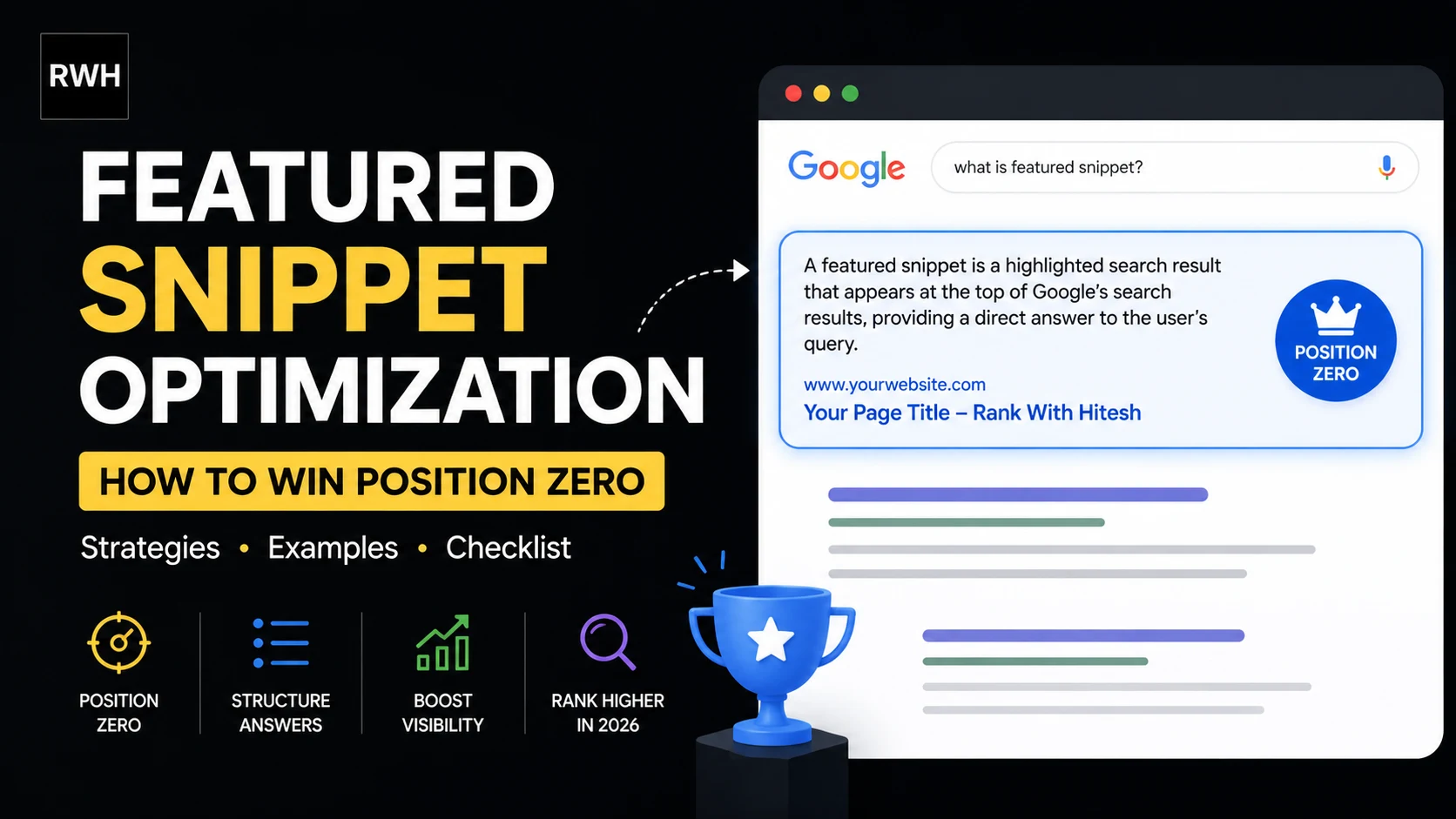
A featured snippet is a special search result that Google displays at the very top of the organic results, often called Position Zero. Instead of just showing your title and meta description, Google pulls a specific piece of content from your page and displays it directly in the search results.
The idea behind them is simple. For questions where the answer is predictable and clear, Google would rather surface that answer immediately rather than make the user click through several pages to find it. Featured snippets serve this purpose by extracting a targeted chunk of content, whether that is a paragraph, a numbered list, a table, or a video.
What makes featured snippets particularly important is their placement. They sit above all other organic results. Even a page ranking in position five can jump to Position Zero if its content structure is right. This makes snippet optimization one of the most cost-effective ways to dramatically increase visibility without needing to climb the rankings further.
Why Featured Snippets Matter in 2026
The way people interact with search results has shifted significantly. AI Overviews now appear on a growing number of queries, and they frequently pull from pages that already hold featured snippets. Getting your content into a snippet position is no longer just about extra clicks. It is about establishing your page as a trusted source that both traditional search and AI-powered search will reference.
Featured snippets also contribute to brand visibility in a way that regular rankings do not. When your content is shown as the direct answer to a question, users associate that authority with your brand, even when they do not click through. Over time, this builds recognition and trust.
There is also the voice search angle. The vast majority of voice-based search responses are pulled directly from featured snippets. As more users interact with AI assistants and voice-enabled devices, snippet optimization becomes the main channel through which your content can be surfaced in those contexts.
In short, if you are serious about organic traffic, impressions, and brand visibility, featured snippets are one of the highest-leverage opportunities available right now.
Featured Snippets vs Traditional Organic Results
Understanding where featured snippets differ from standard organic results helps clarify exactly what you are optimizing for and why the content requirements are different.
| Feature | Featured Snippets | Traditional Organic Results |
|---|---|---|
| Position | Above all organic results (Position Zero) | Position 1 through 10 |
| Visual Format | Answer box with highlighted content | Title, URL, and meta description |
| CTR Impact | High visibility, varies by query type | Depends on rank position |
| Content Requirement | Clear, structured, concise answers | Relevant, well-optimized content |
| Keyword Types | Question-based and informational queries | All query types |
| AI Overview Overlap | Frequently cited in AI Overviews | May or may not appear |
| Ranking Prerequisite | Usually top 10, often top 5 | Standard ranking factors apply |
| Content Formats | Paragraph, list, table, or video | Text-based standard listing |
How Google Chooses Featured Snippets
Google does not choose snippets by looking at ranking position alone. The selection process is driven by a combination of content relevance, formatting quality, and how well the page satisfies the specific search intent behind a query.
When Google processes a question-based search, it scans the top-ranking pages and evaluates which one provides the most direct and clearly structured answer. A page in position three with a well-formatted 50-word definition paragraph will almost always beat a page in position one that buries its answer inside a long introduction.
Several factors influence this selection process. Google looks at whether the content directly addresses the question in the heading. It evaluates whether the answer appears immediately below that heading without filler. It considers the content structure, particularly whether lists, tables, or defined paragraphs are being used. And it weighs the overall topical authority of the page and the domain around that subject.
One important thing to understand is that Google can change which snippet it shows at any time. Snippets are not permanent wins. A competitor can take a snippet from you by improving their content structure, and you can take snippets from competitors by doing the same. This makes ongoing content maintenance just as important as initial optimization.
Types of Featured Snippets
Not all featured snippets look the same. Google uses four main formats depending on the type of query and the content structure it finds on the winning page.
| Snippet Type | Best For | Content Format to Use |
|---|---|---|
| Paragraph | Definitions, "what is" queries, concept explanations | 40–60 word direct answer paragraph directly below H2 |
| Ordered List | Step-by-step processes, ranked items, how-to guides | Numbered HTML list with clear action-oriented steps |
| Unordered List | Feature comparisons, tips, collections, categories | Bullet list with 5–8 concise items per heading |
| Table | Comparisons, pricing, specifications, data sets | HTML table with header row and 3–6 columns |
| Video | Tutorial queries, how-to demonstrations, explainers | Video with descriptive timestamps and matching page text |
Paragraph Snippets
These are the most common type. They appear for definition queries, concept explanations, and anything starting with what is, why does, or how does. Google pulls a short passage, typically between 40 and 60 words, and displays it as a block of text. To target these, you need a concise, direct answer placed immediately below a relevant heading.
List Snippets
List snippets appear for procedural queries and step-by-step questions. Ordered lists are used when sequence matters, such as how to set up Google Search Console or how to conduct a keyword research audit. Unordered lists appear for category-based queries like best on-page SEO factors or types of schema markup. The key to winning these is using proper list markup, not just visually formatted text.
Table Snippets
Table snippets are triggered by comparison queries and data-heavy searches. If someone searches for a comparison of SEO tools or pricing tiers for content platforms, Google may pull a structured HTML table from the ranking page. These require actual table markup in the HTML, not text formatted to look like a table.
Video Snippets
Video snippets appear when Google determines that a visual demonstration best satisfies the query. These tend to appear for tutorial and how-to queries. Having a YouTube video with descriptive timestamps and a page that reinforces the video content in text increases the chances of appearing as a video snippet.
How Search Intent Impacts Featured Snippets
Search intent is the foundation of the entire snippet opportunity. Google only shows featured snippets for queries where the intent is clearly informational. Understanding search intent is critical here, and it is worth reading through a detailed breakdown of search intent for SEO if this concept is new to you.
Transactional queries, branded queries, and navigational searches almost never produce featured snippets. Someone searching for a specific product page or trying to reach a login screen does not need a featured answer. But someone searching for what is anchor text, how to fix crawl errors, or why does page speed matter for SEO is looking for an explanation, and Google will typically display a snippet for those.
This is why question-based keywords are the natural starting point for snippet targeting. The intent is unambiguous, the format expectation is clear, and Google is actively looking for a page that provides a clean direct answer. If you structure your content around answering these questions explicitly, you are already doing the heavy lifting that snippet selection requires.
There is also a secondary intent consideration. Some queries carry mixed intent, where users want both an answer and further reading. For those queries, your snippet answer should be short enough to satisfy immediate curiosity but positioned within a page that offers enough depth to reward a click-through.
Why Top-Ranked Pages Often Miss the Snippet
This is one of the most underappreciated dynamics in SEO. It is entirely possible to rank in position one and not hold the featured snippet for your primary keyword, while a page in position four or five takes it from you. Understanding why this happens is what separates reactive optimization from intentional snippet strategy.
The most common reason is content structure. A page that ranks well because of its backlink profile, domain authority, and overall content depth does not automatically have snippet-friendly formatting. If that page buries its main answer inside a three-paragraph introduction, Google cannot easily extract it. The answer is technically there, but it is not easy to pull as a clean snippet.
Another reason is heading relevance. Google needs to identify which section of your content answers the query. If your H2 says something generic like Overview or Key Takeaways instead of directly mirroring the search question, Google may have trouble matching the section to the query. A competitor who uses an H2 like What Is Internal Link Equity gives Google a much cleaner signal about where the answer starts.
Answer depth mismatch is also a factor. Some highly-ranked pages provide comprehensive, nuanced explanations that are valuable for readers but too complex to extract as a snippet. If every paragraph on the topic is 200 words of dense analysis, Google cannot pull a concise 50-word answer. The page that wins the snippet often provides a short definitional answer first, then goes deeper in subsequent paragraphs.
The lesson here is that ranking and snippet optimization require slightly different approaches. Ranking benefits from depth, breadth, and authority. Snippet optimization requires clarity, structure, and precision. The best content combines both.
How To Find Featured Snippet Opportunities
Before you start optimizing, you need to identify which keywords in your niche are likely to trigger a featured snippet. There are a few reliable ways to do this.
Start with your existing rankings. Open Google Search Console and filter for queries where your page is ranking between positions 4 and 15. These are your highest-opportunity targets because you are already visible, and a format improvement could potentially push you to Position Zero. The query report inside Search Console is the most direct way to find these.
You can layer this with keyword research tools. Filter keyword lists for question-based formats starting with what, how, why, which, can, does, or should. When you see a question keyword where your site already has topical coverage, that is an immediate opportunity. If you are working on building out your site's keyword strategy more broadly, a guide on finding low-competition keywords can help you prioritize.
Also, look at what questions your competitors are winning snippets for. Search for your target topic on Google and note which pages hold the featured snippet. If a competitor in a similar niche or with a similar domain profile is winning snippets, it is strong evidence that the opportunity is accessible through better content formatting.
Entity-based and definition queries are another reliable category. Anything where Google would need to define a term, explain a relationship, or walk through a process is worth reviewing. In SEO specifically, keywords like what is topical authority, how does crawl budget work, or what does canonical tag mean are natural snippet candidates.
Featured Snippet Optimization Strategies
Knowing that a keyword has snippet potential is only half the work. The other half is structuring your content so that Google can confidently extract your answer.
Lead With the Answer
The most reliable formatting change you can make is to place a direct answer immediately below your heading, before any context or explanation. Most writers do the opposite. They set up the topic, explain why it matters, then get to the answer three paragraphs in. For readers who want context first, this works fine. For snippet extraction, it fails because Google cannot cleanly isolate the answer.
Rewrite your target sections so the first 40 to 60 words below the heading answer the question directly. Then you can add context, nuance, and supporting detail afterward. This is the single most impactful structural change you can make for snippet optimization.
Use Question-Based Headings
Your H2 and H3 headings should mirror the exact phrasing of search queries where possible. Instead of writing Content Structure Tips, write How Should You Structure Content for Featured Snippets? Instead of Keyword Research Tools, write What Are the Best Free Keyword Research Tools?
This gives Google a direct signal that the section following the heading is answering that specific question. It also makes your content more conversational and reader-friendly, which aligns with how people actually search.
Format Lists Properly in HTML
If your target keyword calls for a list snippet, your list needs to exist as actual HTML markup. Using dashes or line breaks to create a visual list will not trigger a list snippet. Use ordered ol tags for step-by-step content and unordered ul tags for collections or features. Each item should be concise and begin with an action word or clear noun.
Build Tables for Comparison Queries
For any keyword where users are comparing options, tools, plans, or metrics, a properly built HTML table gives you the best chance at a table snippet. Make sure your table has a descriptive header row and is formatted with actual table tags in the HTML, not a screenshot or styled div layout.
Strengthen Topical Relevance
Featured snippets are more accessible to pages that are part of a topically authoritative site. Google is more likely to extract an answer from a page that exists within a well-developed content cluster covering the subject thoroughly. This is where topical authority in SEO becomes directly connected to snippet performance.
Supporting your target page with strong internal linking from related content also reinforces its relevance signal. A page about on-page SEO that receives internal links from related posts about content structure, keyword targeting, and meta tags signals comprehensive coverage of the topic. You can explore how to build this effectively in a guide on internal linking strategy.
Use Semantic SEO and NLP-Friendly Language
Write in a way that naturally incorporates related terms, synonyms, and entity relationships. Google's ability to understand content has advanced considerably. Covering a topic using semantically related vocabulary helps your page rank for a wider range of queries and makes it more likely to be selected for snippets. Semantic SEO is worth exploring in detail if this is a new concept for you.
Real Example of Featured Snippet Optimization
Here is how this works in practice using an SEO-related content scenario.
Suppose you are writing a guide on keyword cannibalization. Your current content has a section that reads like this:
Before optimized version:
Keyword cannibalization is something that a lot of website owners run into without even realizing it. It happens when you have multiple pages targeting the same or very similar keywords, which can create confusion for search engines. There are several reasons why this might happen and multiple ways to approach fixing it.
This paragraph is readable, but it does not directly answer the question "What is keyword cannibalization" in a snippet-friendly way. The definition is fragmented and buried in context.
Here is how you would rewrite the opening of that section for snippet targeting:
After optimized version:
H2: What Is Keyword Cannibalization?
Keyword cannibalization happens when multiple pages on the same website target the same keyword or search intent, causing search engines to compete those pages against each other instead of surfacing a single strong result. This dilutes rankings, reduces click-through rates, and makes it harder for any individual page to build authority for that query.
The second version uses a direct question as the H2, opens with a clean definition in the first sentence, and covers the essential impact within 60 words. Google can extract that opening paragraph as a complete, standalone answer. The first version cannot be extracted in the same way.
The structural change here is minimal. The content quality difference for readers is minor. But the snippet opportunity is dramatically better.
Common Featured Snippet Mistakes
Even with good intent, there are some recurring mistakes that prevent pages from winning or holding snippets.
- Burying the answer: Writing a strong answer but placing it after two or three setup paragraphs. Google typically picks up content from the very beginning of a section, not from the middle.
- Generic headings: Using headings like Introduction, Overview, or Tips instead of question-based or topic-specific headings. Vague headings do not help Google identify which query your section answers.
- Over-qualifying the answer: Starting your answer with phrases like "It depends" or "There are many factors." For snippet purposes, you need to commit to a direct answer, even if nuance follows in the next paragraph.
- Ignoring list formatting: Writing steps or items as flowing prose when Google is looking for a proper list. If the query calls for a step-by-step answer, your content should use actual list markup.
- Targeting zero-volume question keywords: Optimizing for snippets on keywords that are not being searched often enough to generate impressions. Snippet wins only matter if people are searching for that query in meaningful volume.
- Not monitoring snippet status: Winning a snippet and then ignoring it. Competitors can and do displace snippets, and without monitoring you would not know until your traffic drops.
Featured Snippet Optimization Checklist
Use this checklist before publishing or updating any page you are targeting for a featured snippet.
| ✓ | Optimization Action |
|---|---|
| ☐ | Target question-based keywords with clear informational intent |
| ☐ | Place a direct 40–60 word answer immediately below each H2 heading |
| ☐ | Use question-style H2 and H3 headings that mirror real search queries |
| ☐ | Format list content as proper HTML ordered or unordered lists |
| ☐ | Include comparison tables for any query involving multiple items or options |
| ☐ | Avoid burying the answer inside a long introductory paragraph |
| ☐ | Maintain topical authority by covering the subject comprehensively |
| ☐ | Add internal links to support pages that reinforce the topic cluster |
| ☐ | Use schema markup (Article, FAQPage, BreadcrumbList) for structured data |
| ☐ | Check Google Search Console for queries where you rank in positions 2–10 |
| ☐ | Run periodic checks to verify if you currently hold or lost a snippet |
| ☐ | Update and refresh content regularly to maintain snippet ownership |
Featured Snippets, AI Overviews, and the Future of Search
One of the most significant shifts in SEO over the past couple of years is the rise of AI Overviews in Google search. These are the AI-generated summaries that appear at the top of results for certain queries, synthesizing information from multiple sources into a single paragraph or list.
The relationship between featured snippets and AI Overviews is closely intertwined. Google uses many of the same signals to select content for AI Overviews that it uses for featured snippets. Pages with clear structure, direct answers, strong topical authority, and well-formatted content are more likely to be cited inside AI Overviews.
This means that optimizing for featured snippets is also one of the most direct ways to appear in AI-generated search results. The same concise, structured answer that wins a traditional snippet is exactly what AI systems need to confidently extract and surface.
Conciseness still matters enormously. AI Overview systems prefer content that provides clear, fact-based answers without excessive hedging or jargon. They also favor pages where authority is established through depth, not just breadth. A page that covers a topic thoroughly with real examples and structured explanations will consistently outperform thin pages optimized purely for keyword density.
At Rank With Hitesh, the consistent recommendation has been to treat content structure not as a formatting afterthought, but as a fundamental part of how you approach every piece of content. The way you structure your SEO content writing directly determines how visible it is in every evolving search format.
Looking ahead, the role of featured snippets will likely expand rather than contract. As AI becomes more embedded in how people find information, the ability to surface your content as a trusted, structured source becomes a core competitive advantage. Answer engine optimization is no longer a future concept. It is the present reality of organic search.
Final Thoughts
Featured snippet optimization is not a standalone tactic. It is a natural result of writing content that genuinely prioritizes clarity, structure, and directness. When you answer questions well, format your content correctly, and build topical depth around your subject, snippets follow.
The key insight to carry forward is this: ranking well gets you into the conversation, but content structure determines whether you win the featured position. Both matter, and both deserve deliberate attention.
Start with your existing rankings. Find questions where you are already in the top ten. Audit how your content is structured for those queries. Make the formatting changes. Monitor the results. It is one of the most direct, measurable improvements you can make to your organic search performance right now.
Frequently Asked Questions
A featured snippet is a highlighted search result that Google displays at the top of the results page, above all standard organic listings. It shows a direct answer extracted from a webpage, which can be a paragraph, list, or table, along with the page title and URL. Featured snippets are sometimes called Position Zero because they appear before the first traditional organic result.
To win a featured snippet, start by identifying question-based keywords where your page already ranks in the top 10. Then restructure the relevant section of your content so that a direct, concise answer appears immediately below a question-style heading. Keep the initial answer between 40 and 60 words, use proper list or table markup where the query calls for it, and ensure your page has strong topical coverage of the subject.
Yes, and arguably more so than before. Featured snippets now feed into Google's AI Overviews, making them a key mechanism for appearing in AI-generated search summaries. They also remain the primary way your content gets surfaced through voice search. Pages that consistently win snippets benefit from higher visibility, increased brand recognition, and stronger presence across both traditional and AI-powered search results.
Content that directly answers a specific question, uses clear formatting, and is structured for easy extraction wins featured snippets most consistently. Paragraph snippets favor concise definitions placed immediately below a relevant heading. List snippets favor step-by-step or categorized content using proper HTML list markup. Table snippets favor comparison and specification content in structured table format. In every case, the answer needs to be upfront, not buried.
Yes. Google's AI Overviews draw heavily from content that demonstrates strong structure, clear answers, and established topical authority, which are the same qualities that produce featured snippets. Pages that already appear as featured snippets are more likely to be cited in AI Overview summaries. Optimizing your content for snippet selection is therefore one of the most direct ways to improve your visibility in AI-generated search results.